GROW Observatory
How a European citizen science programme connected observations from the ground with satellite evidence about soil moisture.
GROW was a €5m+ Horizon 2020 Innovation Action coordinated by the University of Dundee. The programme connected 24 GROW communities across 13 countries and brought together expertise spanning environmental science, technology, citizen participation, service design, policy and business innovation.
The consortium included the University of Dundee, FutureEverything, the International Institute for Applied Systems Analysis, the Food and Agriculture Organization of the United Nations, the Met Office, the James Hutton Institute and TU Wien, alongside specialist technology, design and civic organisations. Its wider scientific engagement included the European Space Agency through GROW’s Earth-observation validation work and the World Soils 2019 presentation.
The challenge
Soil moisture matters for agriculture, drought and flood monitoring, yet local measurements have historically been sparse. GROW set out to make citizen observations useful at a scale that could support research, practical growing decisions and Earth observation.
That meant more than distributing sensors: citizens needed ways to participate, gather dependable data and see how their contribution connected to a larger purpose.
Leading service innovation and sustainability
At FutureEverything, George served as GROW’s Service Innovation Work Package Lead, leading WP3: Innovation, Service Development and Sustainability. He connected stakeholder participation and environmental data with service development, business models and financial sustainability, and coordinated SME and commercial data exploitation work, including collaboration with AgroKnow.
He contributed writing across all sections of GROW’s final Business Plan. At the programme’s conclusion, he prepared and presented FutureEverything’s WP3 contribution at the final project review in Brussels, covering service development, SME and open-data innovation, policy, data visualisation, business modelling and the Observatory’s future.
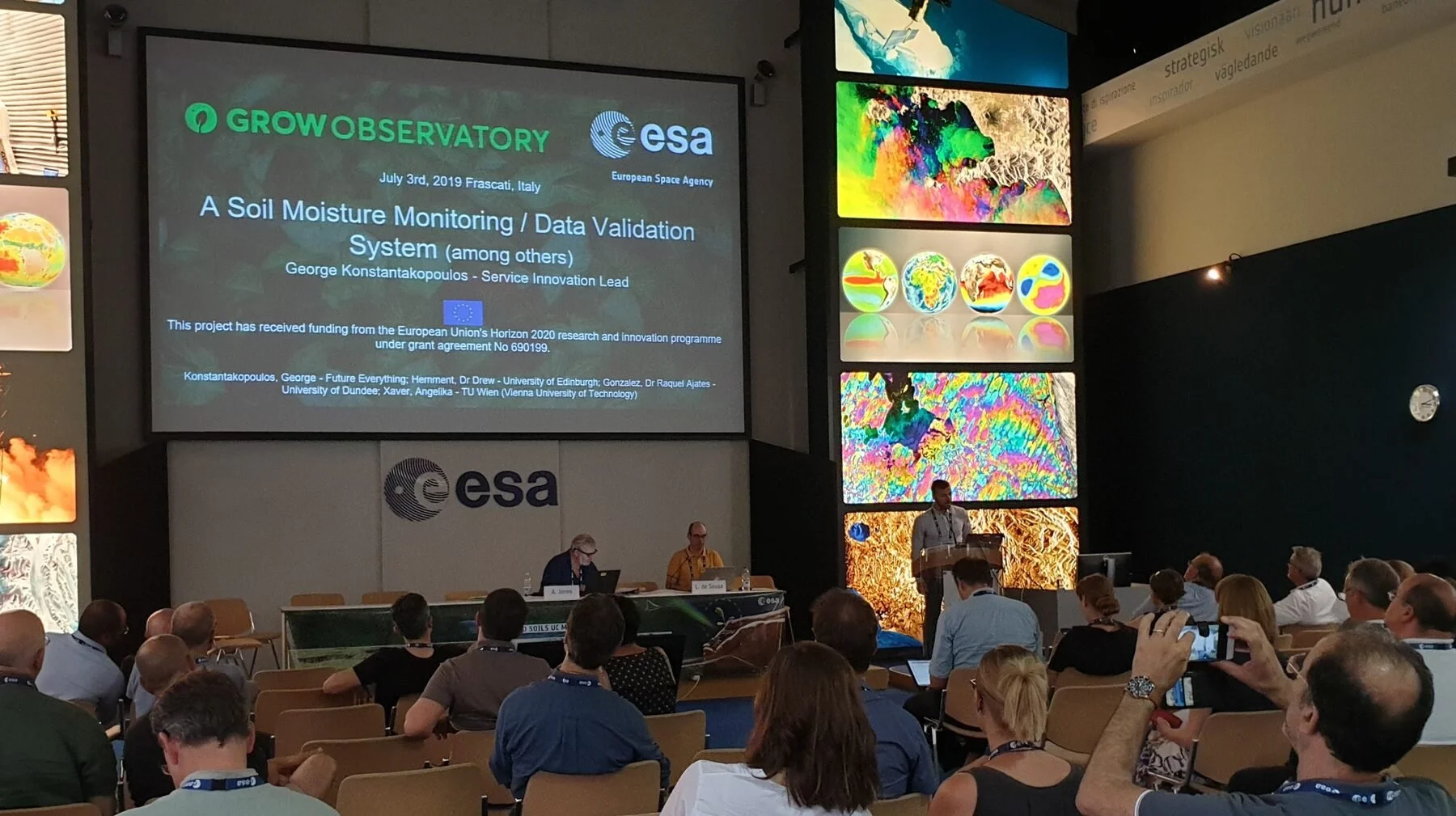
George led the preparation and delivery of GROW’s presentation at the European Space Agency’s World Soils 2019 meeting in Frascati on 3 July 2019, presenting the programme’s soil-moisture validation model, results and recommendations. He was also a key contributor to the Brussels stakeholder policy workshop, connecting perspectives from policy, science, citizen science and agriculture.
He also co-authored a peer-reviewed conference article on citizen engagement, open data and soil moisture monitoring, published in 2020 with consortium colleagues.
The sensor network, data platform and scientific validation were delivered by the wider consortium.
What the programme did
The consortium organised GROW Places and coordinated GROW Missions to build participation in geographically diverse areas. It developed protocols, training, connected soil sensors and data services so local observations could be collected and evaluated alongside satellite products.
It also used online courses and community activity to help people take part in rigorous citizen science over time.
Evidence of outcomes
- 15,000 soil sensors were deployed across Europe, according to the European Commission’s final project report.
- Citizen-generated in-situ measurements were used to validate satellite soil moisture products.
- The co-authored publication describes the linked challenges of sustained engagement, data quality and turning observations into action.
These are reported outcomes of GROW as a whole, not individual performance metrics for George’s work package.
Working with complex evidence and many voices?
Creative Disruption helps define the challenge, design participation and turn learning into a route forward.
Tell us about it ↗Next case study: Social Storm 2015 →